Genomics Beyond Boundaries
Launching at UdeM
Our Research
Our lab explores how geography and population history shape genetic variation. We develop innovative computational methods to study spatial patterns of ancestry across species, enhancing our understanding of evolution, human history, and biodiversity.
Spatial analysis of genetic variation
Quantifying how geographic features influence gene flow and population structure.
Ancestral recombination graphs (ARGs)
Developing computational tools to reconstruct genealogies and ancestry paths.
Population-scale genealogical modeling
Bridging genealogical records with genomic data to study evolutionary dynamics.
Applications to conservation biology
Using genetic methods to inform strategies for endangered species.
Human genetic diversity and history
Uncovering migration and demographic events that shape human genetic variation.
Meet the Team
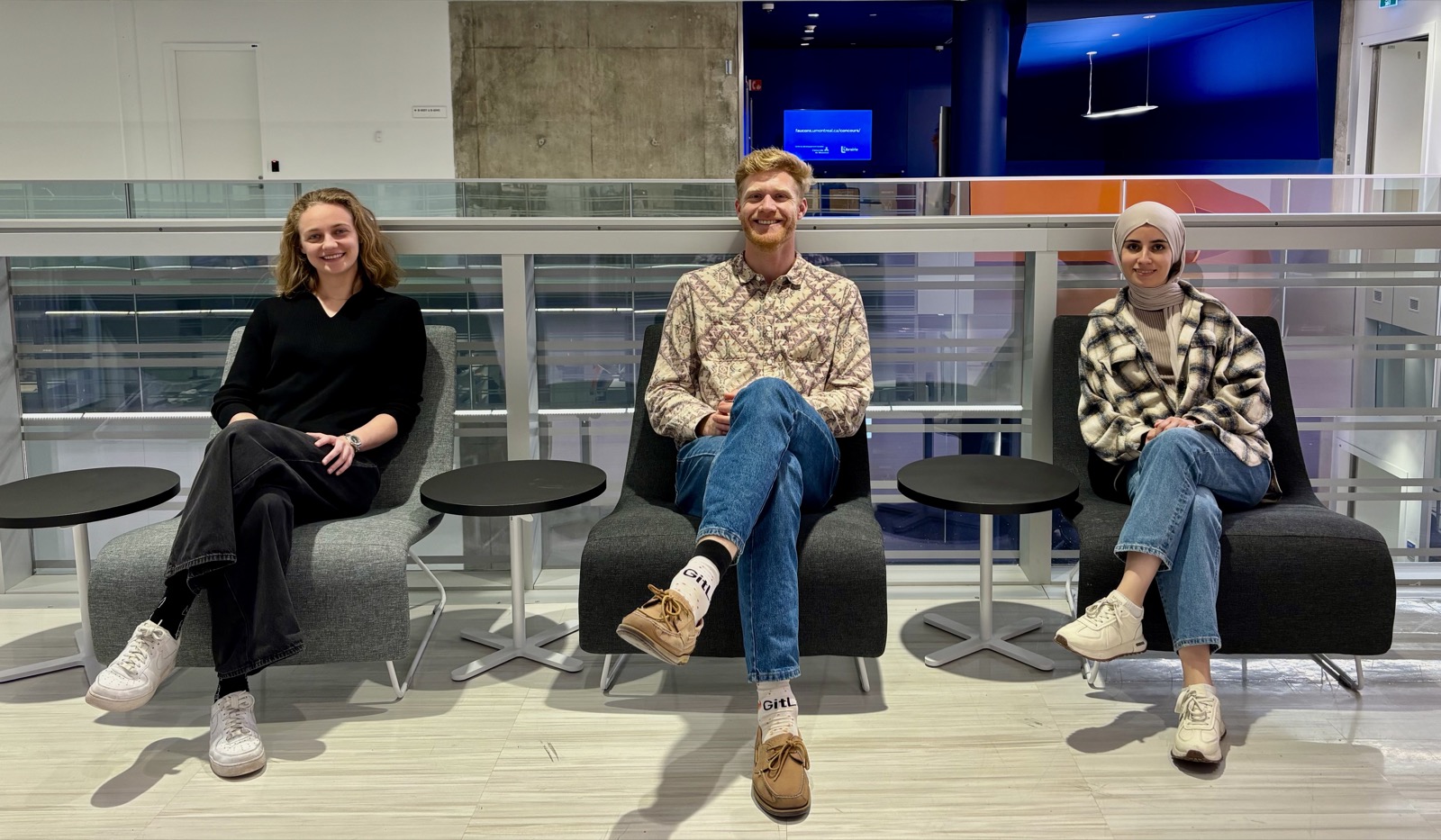

Luke Anderson-Trocmé
Principal Investigator

Lylia Dehas
MSc student, UQAM
Co-supervised with Hakim Lounis. Trained in computer science, she builds simulations of family trees to study how migration and mate choice shape genetic diversity in founder populations like Quebec.
Chloé Matta
PhD student, Université de Montréal
A doctoral student in bioinformatics with a background in microbiology, she designs interactive visualizations that make population genetic data legible — both for clinical researchers and for anyone curious about their own ancestry.

Brian
Lab Mascot / Wellness Officer
Chief morale officer and nap specialist.
This could be you!
Open positions coming soon
We're recruiting MSc, PhD, and postdoc candidates.
Selected Publications
- On ARGs, pedigrees, and genetic relatedness matrices
Genetics · 2026
- A multi-ancestry genetic reference for the Quebec population
Nature Communications · 2026
- On the genes, genealogies, and geographies of Quebec
Science · 2023
- Topological stratification of continuous genetic variation in large biobanks
Preprint 2023
News & Updates
- ASHG 2026 in Montreal October 2026
Both lab students are presenting posters at the ASHG Annual Meeting. Chloé Matta — board 4010T. Lylia Dehas — board 7039W. Come say hi.
- The lab has a sticker October 2026
Our first lab sticker is out in the world. Find us at ASHG to grab one.

- New paper in Genetics January 2026
Our paper on ARGs, pedigrees, and genetic relatedness matrices is now published in Genetics.
- Quebec reference panel published January 2026
A multi-ancestry genetic reference for the Quebec population is now out in Nature Communications.
- Lab launch August 2025
The Anderson-Trocmé Lab officially opens at Université de Montréal.
- Hello World! May 2025
Our lab website is now live. Stay tuned for updates on upcoming research projects, opportunities, and more!
Join the Lab
We build computational tools to understand how populations evolve across space and time. If you like code, data, and hard problems — let's talk.
Interested in MSc, PhD, or postdoc positions? Reach out to discuss timing and fit.
Learn more →Contact
Email: luke[dot]anderson-trocme[at]umontreal[dot]ca
Address:
Département de biologie, Université de Montréal,
Campus MIL, bureau B-5411